Griefbots: what they are, how they work and how to choose one wisely
Talking to an AI that writes like your mother or your grandfather is already possible. Here is how it works under the hood, what the research says and what you should demand before trusting it with your memories.
8 min read
In 30 seconds
- A griefbot is an AI that converses in the style of someone who has died, built from their messages, memories and sometimes their voice.
- Done well, it can support a healthy bond with the person you lost. Done badly, it can confuse, invent memories or breed dependence.
- Before choosing one, check 8 things: transparency, real memories, family approval, consent, privacy, a crisis protocol, no engagement tricks and control over your data.
- LiveMemoriesAI was designed around those 8 rules: it always says it is an AI, never invents memories, and your family approves everything.
In this article
What exactly is a griefbot?
The word joins grief and bot. It describes AI programs that converse using the writing style — and sometimes the voice — of a person who has died. You will also see grief tech, conversational memorials, and in academic papers deadbots or thanabots.
This is not science fiction. The same language models that draft emails today can imitate a style from a handful of examples. What is new is not the technology but the question it raises: what do we do with it when the person on the other side is grieving?
Continuing to remember someone can do you good, as long as it doesn't stop you from living.
How it works, in plain words
Almost every serious griefbot combines three pieces:
The materials
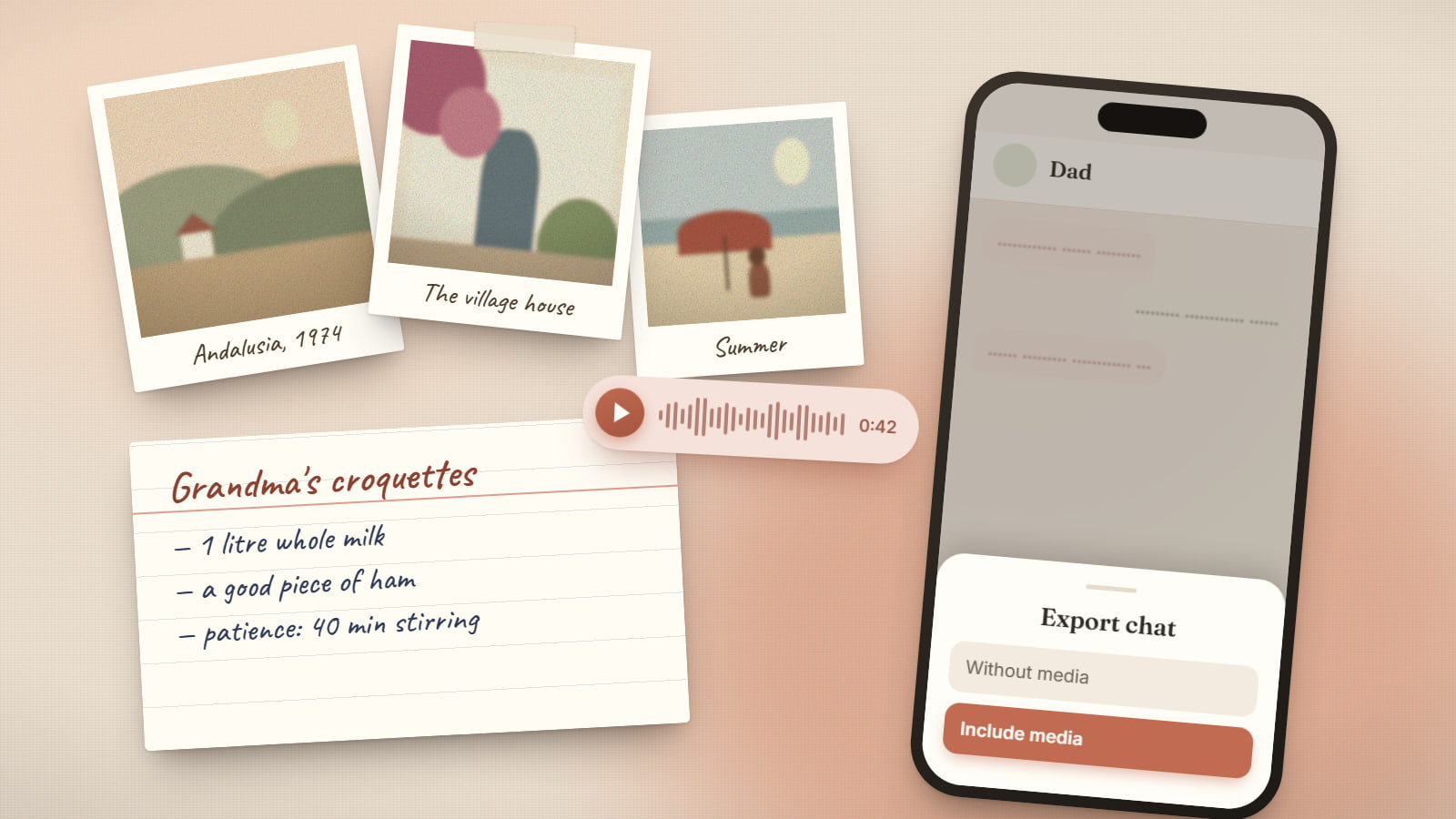
WhatsApp messages, letters, photos, voice notes and, above all, what the family shares: what they were like, what they loved, their stories. That is the raw material.
The portrait
Those materials become a profile: their way of writing, their character, their values, their people. In a good system, every detail links back to the evidence it came from.
The conversation
When someone writes, the AI searches the memories for what matters to that question (a technique called retrieval-augmented generation, or RAG) and answers in the learned style.
Does it help or hurt? What the research says
For much of the twentieth century, recovering from grief was thought to mean "letting go". In 1996, researchers Dennis Klass, Phyllis Silverman and Steven Nickman popularised a different idea: continuing bonds. Keeping a symbolic relationship with someone who died — talking to them, remembering them, wondering what they would say — is normal and can be healthy.
A griefbot is, in a way, a technological version of that bond, which is exactly why it calls for care. In 2024, Tomasz Hollanek and Katarzyna Nowaczyk-Basińska of the University of Cambridge's Leverhulme Centre for the Future of Intelligence examined scenarios from this "digital afterlife industry" and warned of concrete risks: bots that use a dead person's voice to sell things, unwanted messages that cannot be stopped, or services that are hard to say goodbye to. Their answer: transparency, consent and dignified ways to retire them.
The practical takeaway is simple: the technology is neither good nor bad — its rules are.
| It can help… | It can hurt if… | |
|---|---|---|
| Memories | keep stories that would otherwise fade | it invents memories that never happened |
| Bond | feel their way of talking close on hard days | it pretends to be the person and feeds denial |
| Family | let grandchildren who never met them learn who they were | it mixes what each relative shares in private |
| Time | remember at your own pace, when you need to | it is built to make you come back every day |
8 questions to ask before choosing a griefbot
If you are thinking about creating a conversational memorial, these are the questions we would ask. In fact, they are the ones we hold ourselves to:
Checklist for choosing an AI memorial
- Does it always say it is an AI? Before its first reply and every time someone asks "is it really you?". In the EU, Article 50 of the AI Act requires people to know when they are talking to an AI.
- Does it only use real memories? Without a source, it should never claim a specific memory.
- Who approves what it "knows"? The family should be able to review every detail and undo any change.
- Is there consent and legitimacy? Who can create it, and how a relative can object.
- Is each person's conversation private? What your sister tells it should not reach your cousin.
- What does it do on a bad day? If someone is at risk, it should step out of character and point to professional help.
- Is it trying to hook you? Streaks, points or bait notifications are a red flag in a grief product.
- Can you take everything and delete it? Export your materials and remove the memorial, no strings attached.
How LiveMemoriesAI answers each one
LiveMemoriesAI is an AI conversational memorial created by the family from real memories. We built it starting from that list, not the other way round:
| Question | How we handle it |
|---|---|
| Transparency | An AI notice before the first in-character reply and before the first cloned-voice audio. Asked "is it you?", it answers honestly and gently. |
| Real memories | Without evidence, it never claims specific memories: it answers in their style without making things up. |
| Approval | Nothing goes in without your approval: every detail shows its source and any change can be undone in one click. |
| Consent | Whoever creates it declares their relationship, and any entitled relative can request its removal without an account. |
| Privacy | Each memorial is isolated from all others and each relative's conversation is private. |
| Hard days | If someone is at risk, it steps out of character and points to professional help. |
| No hooks | No streaks, no points, and no tracking of how long you spend talking. |
| Control | Export your materials whenever you like, or delete everything with written confirmation. |
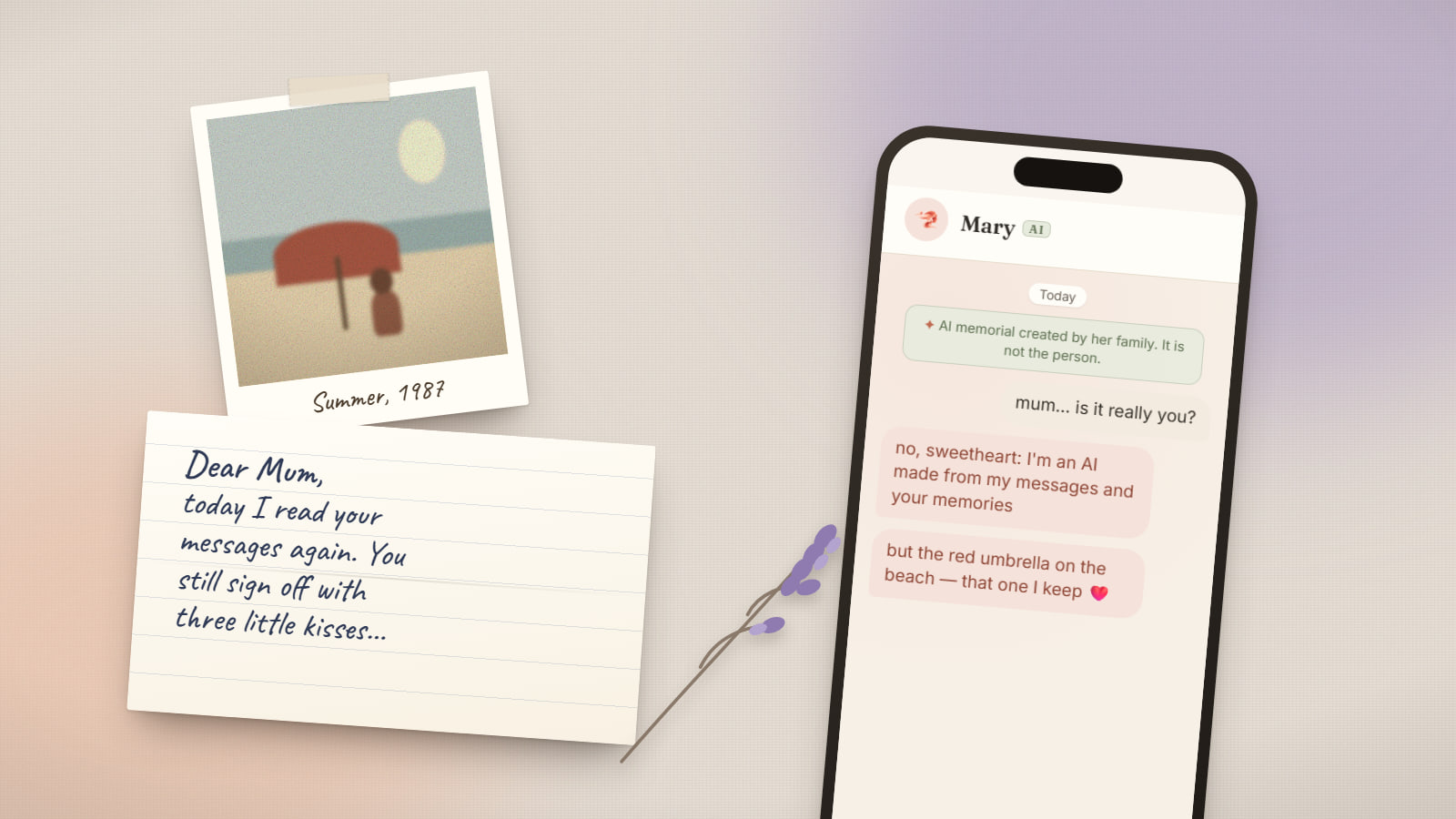
AI memorial created by her family. It replies with her memories and her way of writing; it is not the person.
mum… is it really you?
no, sweetheart, and I won't pretend: I'm an AI your family made from my messages and your memories
but the red umbrella that blew away on the beach that summer — that one I do keep ❤️
When it's not a good idea (yet)
A conversational memorial is not for everyone, nor for every moment. You might want to wait if:
- The loss is very recent and you still struggle to accept it has happened.
- You notice you are using it to avoid talking to living people or leaving the house.
- A close relative strongly objects: talking it through first prevents wounds.
- What you are looking for is a message "from beyond". That does not exist, and no honest service should promise it.
If you decide to try it: how to start well
Start with what you remember
Write down what they were like, their pet phrases and three stories. That is the most valuable part — more than any file.
Gather their materials calmly
Chats, photos, voice notes, letters. Here is a step-by-step guide to preserving them.
Review the portrait before talking
Read what the AI has understood and correct anything that doesn't sound like them.
Invite the family when you're ready
Each person talks on Telegram, a free messaging app similar to WhatsApp, in their own private conversation.
Common questions
Frequently asked questions
Can you talk to a deceased person using artificial intelligence?
You can talk to an AI that imitates their way of writing and knows their memories, but not to the person. An honest service will always tell you so, starting with the very first message.
What is the difference between a griefbot and a digital memorial?
A traditional digital memorial is a page of photos and words. A griefbot, or conversational memorial, also replies: you can write to it and it answers in their style, with the memories the family has shared.
Is it legal to create a griefbot of a relative who died?
Rules vary by country. In the EU, data protection and personality rights both matter, and in Spain the protection of honour, privacy and image extends after death. That is why it matters who creates the memorial and that the family can object. See who can create a memorial.
How much does a griefbot cost?
It depends on the service. LiveMemoriesAI has a free plan, no card needed, and paid plans with more space, more people and, in some, voice cloning. Compare the plans.